One of the best understood ideas in economics is that if you make something harder and more expensive, you get less of it. Unfortunately, Hattiesburg is applying that idea to development. For years I’ve said we make it incredibly difficult to build or renovate anything in our city. It is literally easier in Hattiesburg to let your roof fall in than to replace it.
In this post, I want to show how that hurts us with the quantitative data. Last month I bought the Forrest County real property tax rolls for 2015 and 2025 from Delta Computer Systems. For $700, you get two 17 MB files detailing every tax parcel in Forrest County, and they are incredibly revealing.
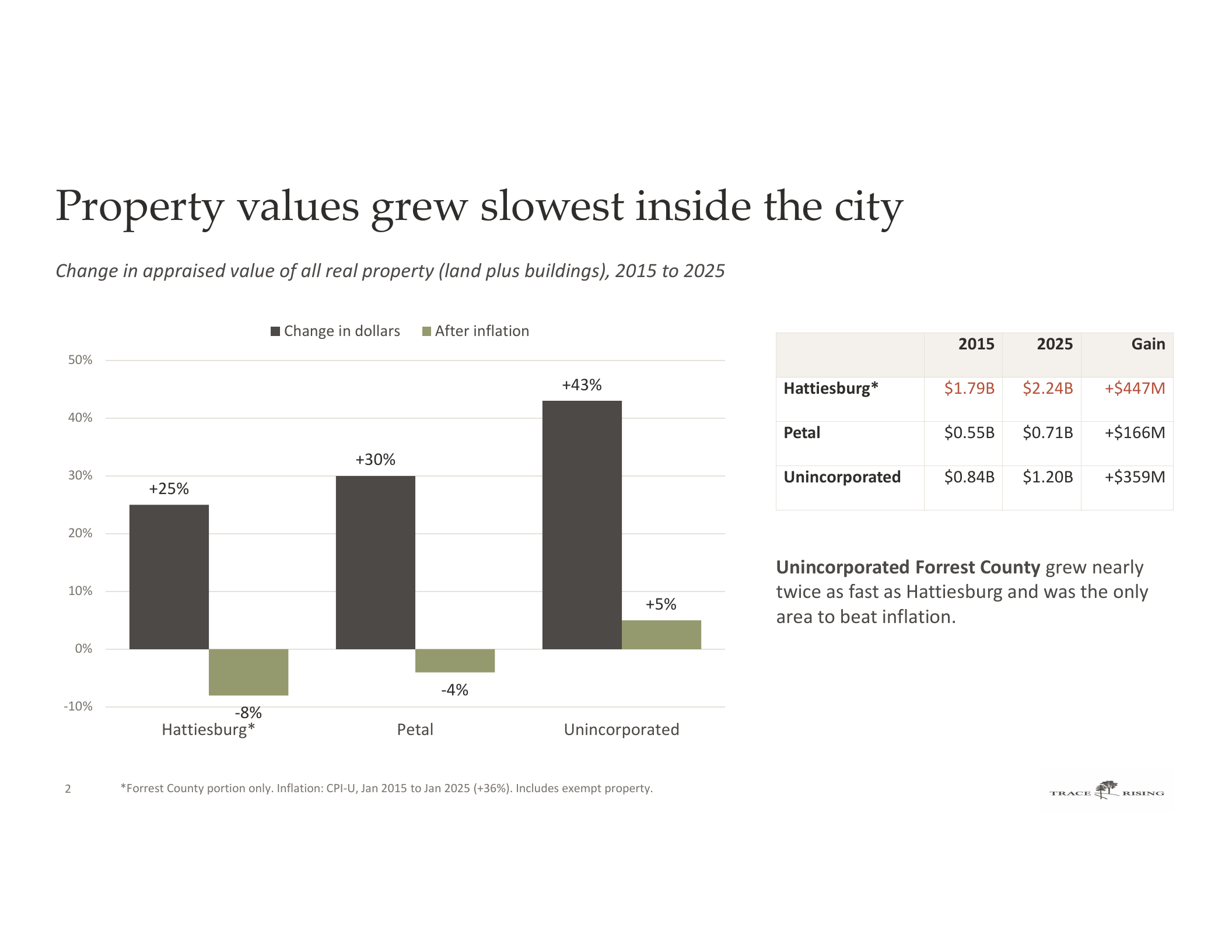
Over those ten years, the appraised value of real property grew 25% in the Forrest County portion of Hattiesburg, 30% in Petal, and 43% in unincorporated Forrest County. Adjusted for inflation, values shrank 8% in Hattiesburg and 4% in Petal, and grew 5% in unincorporated Forrest County. It’s worse for the part that pays the bills. About a fifth of Hattiesburg’s gain was tax-exempt property, so the city’s taxable value grew only 22%, which means it shrank about 10% after inflation. And on that same inflation adjusted taxable value basis, both Petal and unincorporated Forrest County grew. For my own mental health, I am going to try really hard to not run this analysis on any part of Lamar County.
The problem isn’t that people don’t want to live in Hattiesburg. I also compared every house that existed in both 2015 and 2025. The median existing house gained 22% in value in Hattiesburg, 19% in Petal, and 17% in unincorporated Forrest County. If people were avoiding the city, those numbers would run the other way.
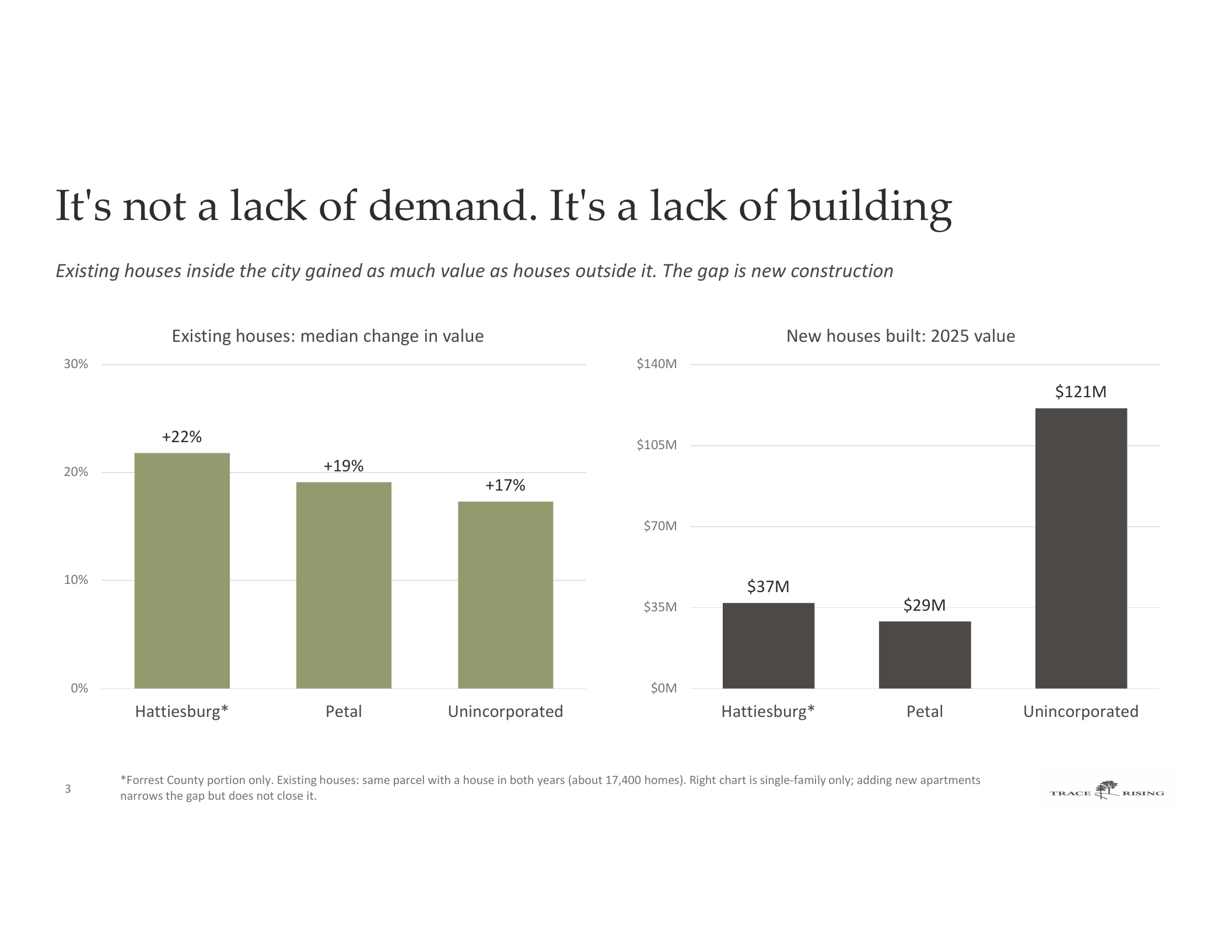
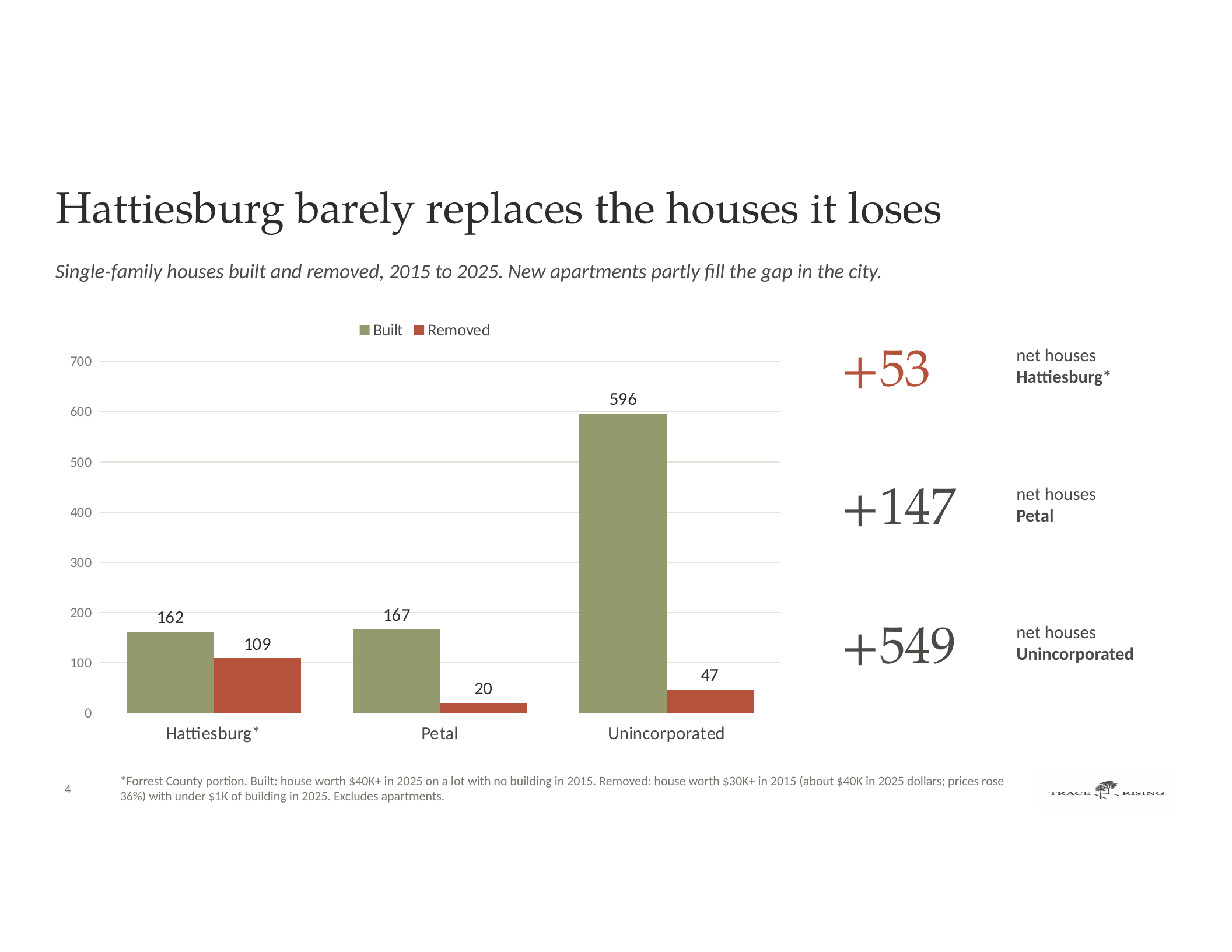
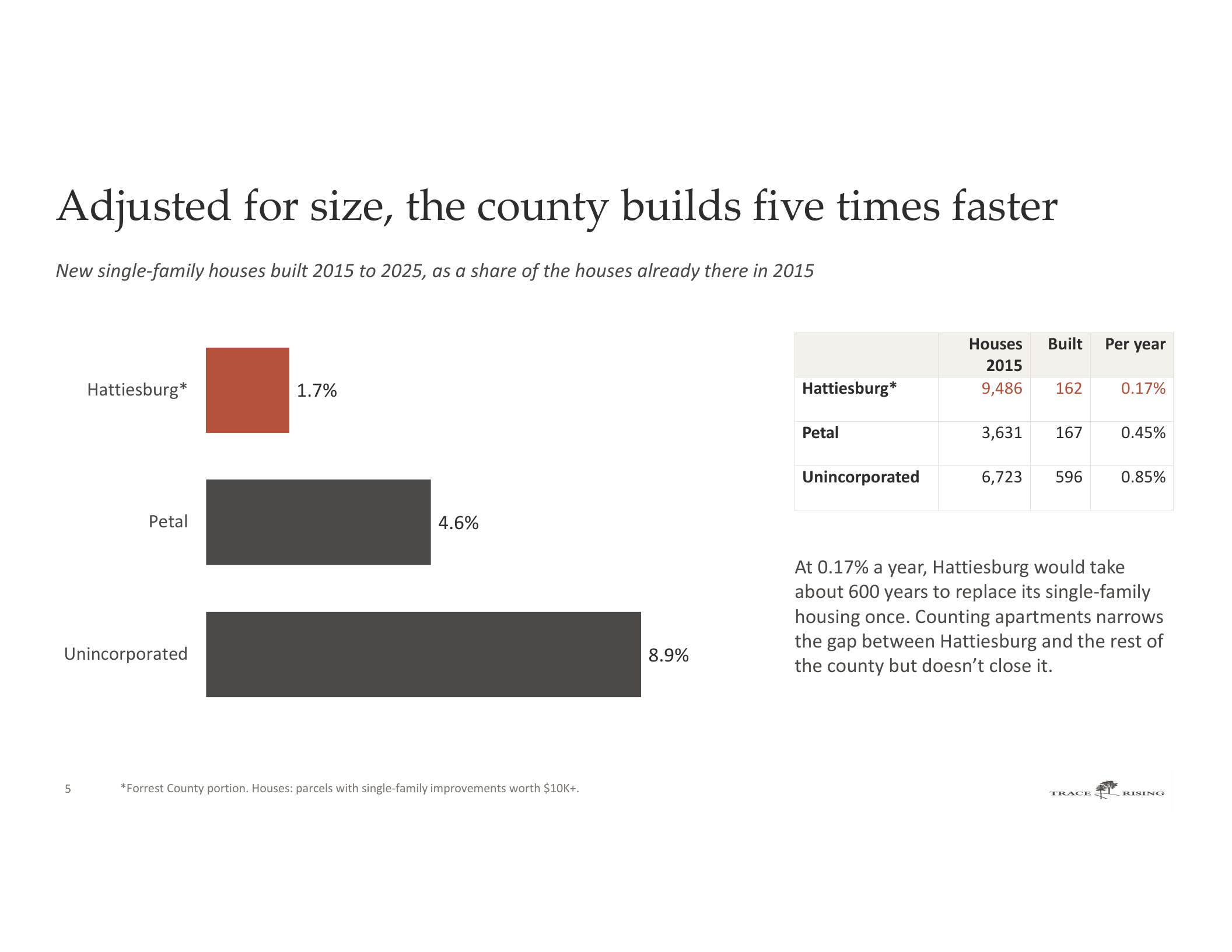
The problem is that we stopped building. Petal, about a third the size of the Forrest County portion of Hattiesburg, built more new houses than we did. Unincorporated Forrest County, with 29% fewer houses than we have, built more than three and a half times as many. Between a tornado, the usual fires and other losses, and some blight removal, Hattiesburg lost about 110 houses and built about 160, ending the decade barely ahead. Petal netted about 150 and unincorporated Forrest County about 550. New apartments, mostly student and senior housing and downtown lofts, added some housing in the city, but nowhere near enough to close that gap.
Here’s a crazy stat: the City’s land development code is growing faster than single family houses as a percentage of its base - 0.95% per year versus 0.06% per year!
Why does this matter? Salaries for firefighters, police, teachers and other public employees have to rise at least with inflation if we want to keep good people, and the cost of building and repairing city infrastructure has risen faster than inflation. If our property tax base isn’t growing at least as fast as inflation, we have three choices: 1) raise tax rates by increasing millage, 2) cut city services, or 3) find the money somewhere else. Over the years, our city has mostly chosen option three by annexing growing areas outside the city limits. Hattiesburg has grown from about 20 square miles in 1980 to about 54 today. That’s a short-term sugar fix. We eventually have to serve those areas too, and by expanding our footprint while our density falls, we build a city that costs more to run every year. Police, fire, roads, water and sewer cost about the same per mile whether a street has 5 houses or 50. And people on the edge still drive into town for jobs, shopping and doctors, which clogs the roads for everyone.
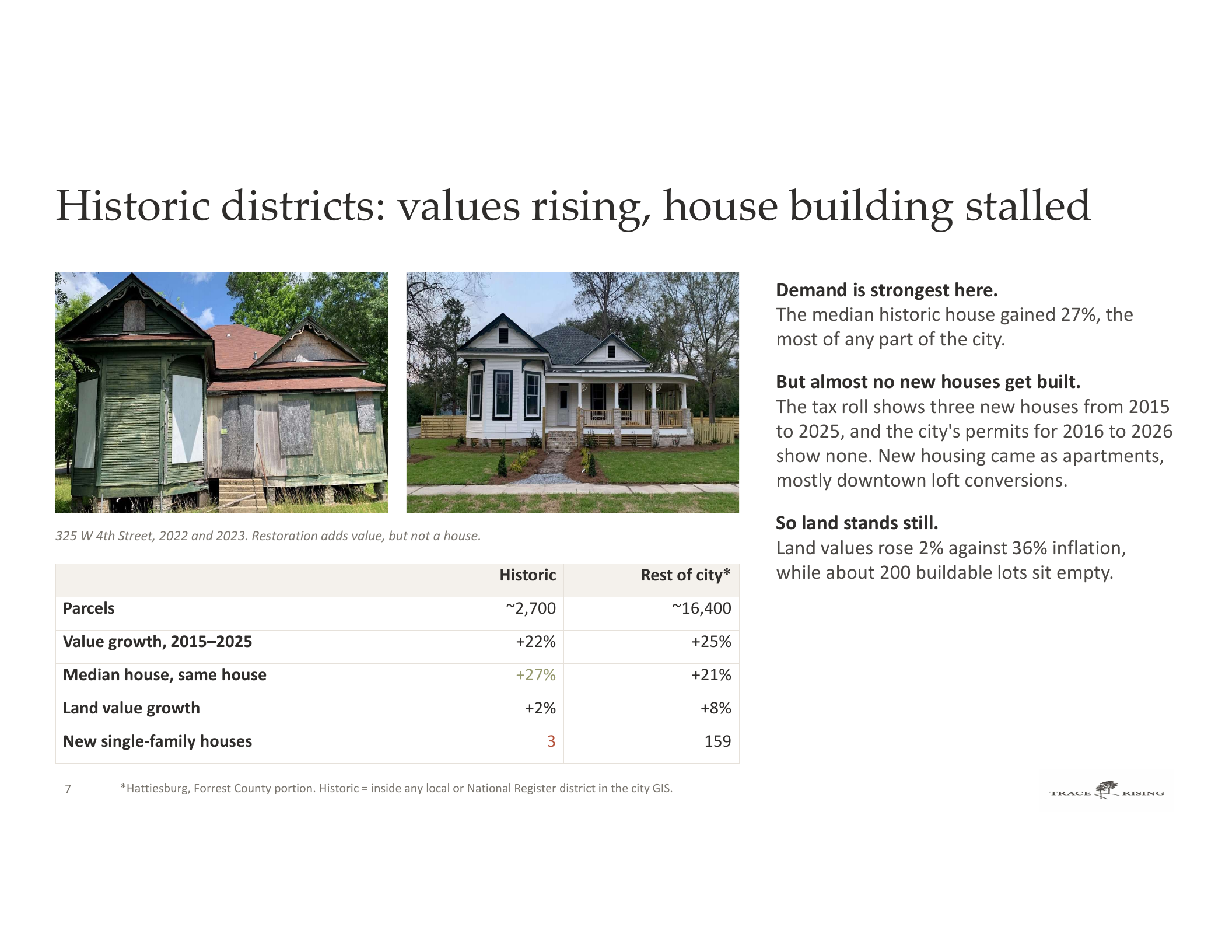
Most of my friends know that my heart is downtown because as downtown goes, so goes our City. Our historic districts, which are harder to build in, paint a more troubling picture. The city’s own records show we haven’t built a single new house in the historic districts in 10 years. It isn’t for lack of land. There are more than 200 buildable lots in the historic districts as compared to more than 2,500 in the Forrest County section of the City overall. It isn’t for lack of demand either. The median house in our historic neighborhoods gained 27% in value, compared with 21% in the rest of the city during this period. It’s because we make it too hard to build.
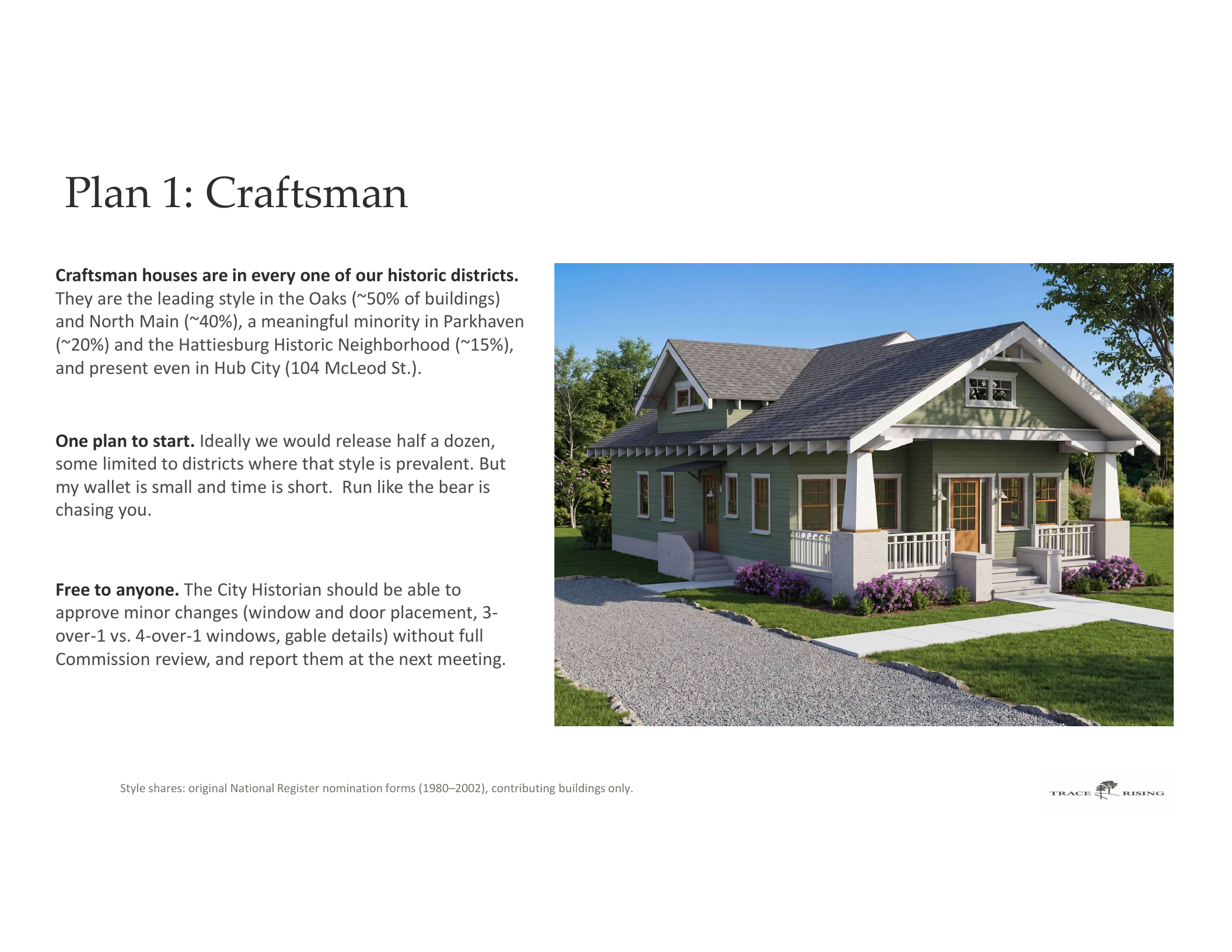
Next week I’ll propose a Pattern Development program to the Historic Conservation Commission, and I’m willing to build the first house myself next door to my own. Under Pattern Development, the city approves a few house plans once, in public. Builders then skip pre-application and Historic Commission review, and permitting moves faster because staff already know the plans. The idea isn’t new. Kalamazoo, MI, South Bend, IN, Cincinnati, OH and others offer free pre-approved house plans. In Macon, Georgia’s Beall’s Hill historic district, once the historic commission approves a design, staff can sign off on any house built to it.
We deserve beautiful things. Let’s go build them.